
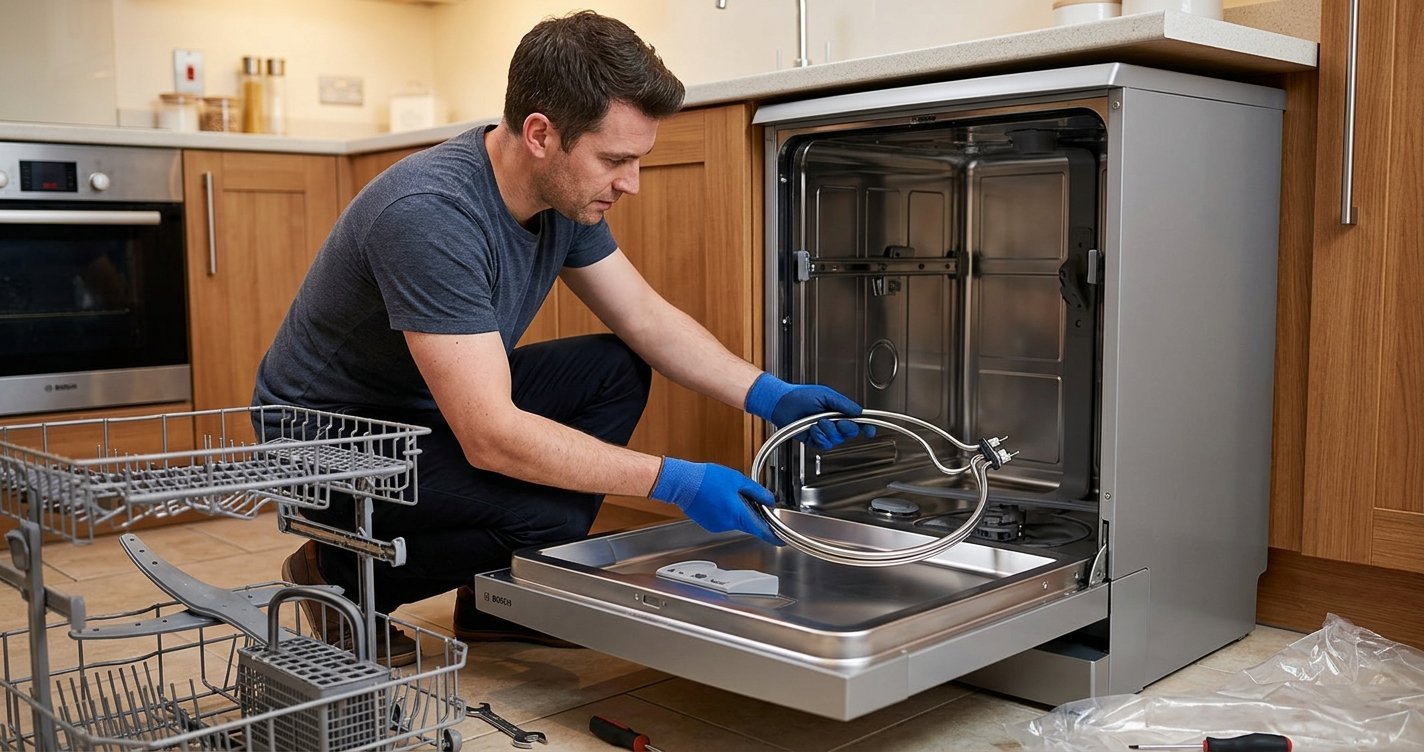
Replacing a heating element on a Bosch dishwasher can restore proper water heating and drying when the original heater has failed. However, Bosch dishwashers use different heating systems and assemblies depending on the model, so the exact removal procedure and replacement part vary.
The safest approach is to identify the dishwasher’s E-Nr. (model number) first, then use Bosch’s parts and service information for that exact appliance. Bosch specifically recommends using the E-Nr. to identify compatible replacement parts. BBosch Home+1
Quick Overview
| Item | Typical requirement |
| Difficulty | Moderate to advanced |
| Time | About 1–3 hours |
| Main tools | Screwdrivers, pliers, nut driver/socket set |
| Replacement part | Model-specific Bosch heater/heating assembly |
| Power | Disconnect dishwasher from electrical supply |
| Water | Shut off water supply before disconnecting hoses |
| Model identification | Bosch E-Nr. from the rating plate |
| Important | Take photos of wiring and hose connections before removal |
Safety first: A dishwasher combines mains electricity and water. Disconnect power at the circuit breaker or fuse before working on it, and do not work on the appliance while it is energized.
Before You Start: Confirm the Heating Element Is the Problem
A dishwasher that does not heat properly does not necessarily have a failed heating element. Other causes can include wiring, temperature sensors, control electronics, water circulation problems, or related components.
Common symptoms of a heating problem include:
- Dishes remain cold or unusually wet after a cycle.
- Water does not appear to get hot.
- The dishwasher takes much longer than normal to complete a cycle.
- Cleaning performance has deteriorated.
- A heating-related fault code appears on some models.
Because Bosch uses multiple heating designs, don’t order a generic “Bosch dishwasher heating element” based only on appearance. Bosch’s parts catalog contains different heating assemblies, and compatibility is checked using the appliance’s E-Nr. BBosch Home+1
Tools and Parts You May Need
- Correct Bosch replacement heating element or heating assembly
- Torx screwdriver set
- Phillips/flat-head screwdriver
- Nut driver or socket set
- Pliers
- Towels or a shallow container for residual water
- Work gloves
- Flashlight
- Camera or phone for recording wiring connections
Bosch’s official parts finder lets you enter the E-Nr. to see the parts associated with your specific dishwasher. BBosch Home
Step-by-Step: Replacing the Bosch Dishwasher Heating Element
1. Find the Bosch E-Nr.
Open the dishwasher door and look around the door area or on the appliance’s rating plate for the E-Nr.
Write down the complete number, including the characters after the slash if present.
Bosch uses this number to provide model-specific manuals, parts and service information. BBosch Home+1
2. Switch Off the Electrical Supply
Turn the dishwasher off and disconnect it from the electrical supply.
For a hardwired dishwasher, switch off the appropriate circuit breaker and verify that the appliance is no longer receiving power.
Do not rely only on the dishwasher’s front-panel power button.
3. Shut Off the Water Supply
Close the dishwasher’s water-supply valve.
If you need to pull the appliance out, have towels ready because a small amount of water can remain inside the inlet or drain system.
4. Remove the Lower Access Panels
Depending on the Bosch model, you may need to remove the lower kick plate or access panels to reach the components underneath the tub.
Keep screws organized by location.
Important: Bosch models differ considerably here. Don’t force a panel if it does not release after removing its retaining screws; check the model-specific installation or service documentation first.
5. Pull the Dishwasher Out if Necessary
If the heating assembly is underneath the dishwasher, carefully remove the mounting screws securing the appliance to the countertop or cabinets.
Lower adjustable feet if necessary and slowly slide the dishwasher forward.
Protect the flooring while moving the appliance.
6. Photograph the Wiring and Connections
Before disconnecting anything, take several clear photographs.
Capture:
- Electrical connectors
- Ground wires
- Hose connections
- Clips and brackets
- Orientation of the heating assembly
This makes reassembly much easier and helps prevent wiring mistakes.
7. Locate the Heating Assembly
The exact location depends on the Bosch dishwasher design.
Some Bosch dishwashers use a conventional heating element, while others incorporate the heater into a heating-pump or circulation/heating assembly. Bosch’s parts catalog itself lists dishwasher heating-related assemblies such as drain and heat pumps and model-specific heater assemblies. BBosch Home+1
This distinction is important: you may not be able to replace a separate heating element on your particular Bosch model because the heater is part of another assembly.
8. Disconnect the Electrical Connectors
Once you have access to the heater:
- Confirm power is disconnected.
- Photograph the connections again.
- Release the electrical connectors.
- Do not pull on the wires themselves.
- Inspect the terminals for burning, corrosion or melted plastic.
If the wiring or connector is damaged, replacing only the heating element may not solve the problem.
9. Disconnect Any Necessary Hoses or Components
If your model’s heater is integrated into the circulation/heating system, additional hoses or components may need to be removed.
Use towels to catch residual water.
Before disconnecting each hose, photograph its routing and mark connections if necessary.
10. Remove the Old Heating Assembly
Remove the retaining screws, clips, clamps or locking mechanism specified for your model.
Carefully release the heating component.
Avoid prying against plastic housings or the dishwasher tub because these components can be damaged.
11. Compare the Replacement Part
Before installing the new component, compare it with the old one.
Check:
- Connector positions
- Mounting points
- Overall shape
- Seals and O-rings
- Electrical specifications
- Part number
Do not assume that two visually similar Bosch heaters are interchangeable. Bosch lists multiple dishwasher heating assemblies and requires the E-Nr. for compatibility checking. BBosch Home+1
12. Install the New Heater
Install the replacement in the same orientation as the original.
Replace seals or O-rings when the replacement procedure calls for them. Make sure the assembly seats correctly before tightening its fasteners.
Do not overtighten plastic fittings.
13. Reconnect the Wiring and Hoses
Reconnect everything exactly as documented in your photographs.
Check that:
- Every electrical connector is fully seated.
- Ground connections are restored.
- Hose clamps are secure.
- Hoses aren’t kinked.
- No wires are trapped against moving or hot components.
14. Reassemble the Dishwasher
Replace the lower panels and return the dishwasher to its original position.
Reconnect the water supply and electrical connection according to the appliance’s installation instructions.
Before pushing the dishwasher completely back into the cabinet, inspect underneath for leaks.
15. Test the Dishwasher
Run an appropriate test or wash cycle.
Watch carefully for:
- Water leaks
- Unusual electrical smells
- Abnormal noises
- Error codes
- Failure to heat
- Circuit-breaker trips
If the breaker trips or you smell burning, stop the test immediately and disconnect the appliance from power.
Common Mistakes to Avoid
- Ordering by appearance: Bosch has multiple heater designs and assemblies.
- Skipping the E-Nr.: The E-Nr. is the most reliable way to identify the correct part.
- Working with power connected: Always isolate the electrical supply first.
- Replacing the heater without diagnosing the fault: A sensor, wiring problem or control component can produce similar symptoms.
- Reusing damaged seals: A leaking heating assembly can cause further damage.
- Forgetting the ground connection: This is an important safety connection.
- Forcing components apart: Bosch dishwasher construction varies between series and production revisions.
When You Should Use a Bosch Technician
Consider professional service if the heating component is integrated into a circulation/heating pump, you cannot confidently identify the correct replacement, wiring is damaged, or the dishwasher continues to trip the circuit breaker after the repair.
Bosch provides model-specific service information, manuals and repair resources through its Service Assistant. BBosch Home+1
Frequently Asked Questions
How do I know which heating element fits my Bosch dishwasher?
Use the dishwasher’s E-Nr. rather than ordering based on the dishwasher’s series name alone. Bosch’s parts finder uses the E-Nr. to identify compatible parts. BBosch Home+1
Is the Bosch dishwasher heating element always a separate part?
No. Depending on the model, the heating function can be associated with a larger heating/circulation assembly. Bosch’s parts catalog shows multiple types of dishwasher heating assemblies. BBosch Home+1
Can I replace the heating element myself?
A technically confident DIYer may be able to do it, but access can require removing the dishwasher and working around electrical and water connections. If your model uses an integrated heating-pump assembly, the job can be substantially more involved.
Where can I find the correct Bosch replacement part?
Start with Bosch’s official Dishwasher Spare Parts finder and enter the complete E-Nr. Bosch also provides model-specific manuals and support through its Service Assistant.
Bottom Line
Replacing a Bosch dishwasher heating element is possible on many models, but there is no single replacement procedure that applies to every Bosch dishwasher. Identify the E-Nr., confirm the exact heating design and compatible part, disconnect both electrical and water supplies, document every connection, and follow the model-specific service instructions.
For the most accurate procedure, the exact Bosch E-Nr. is essential.