
A dishwasher cleans your dishes every day, but over time, it can also collect grease, mineral deposits, food residue, and unpleasant odors. Regular cleaning helps keep the appliance fresh and performing well.
So, which one is better?
The answer depends on what you want to remove. Dishwasher cleaner is generally the more targeted option for deep cleaning and maintenance, while vinegar can be a simple, inexpensive choice for occasional cleaning and odor control.
Read More: How Does Dishwasher Cleaner Work?
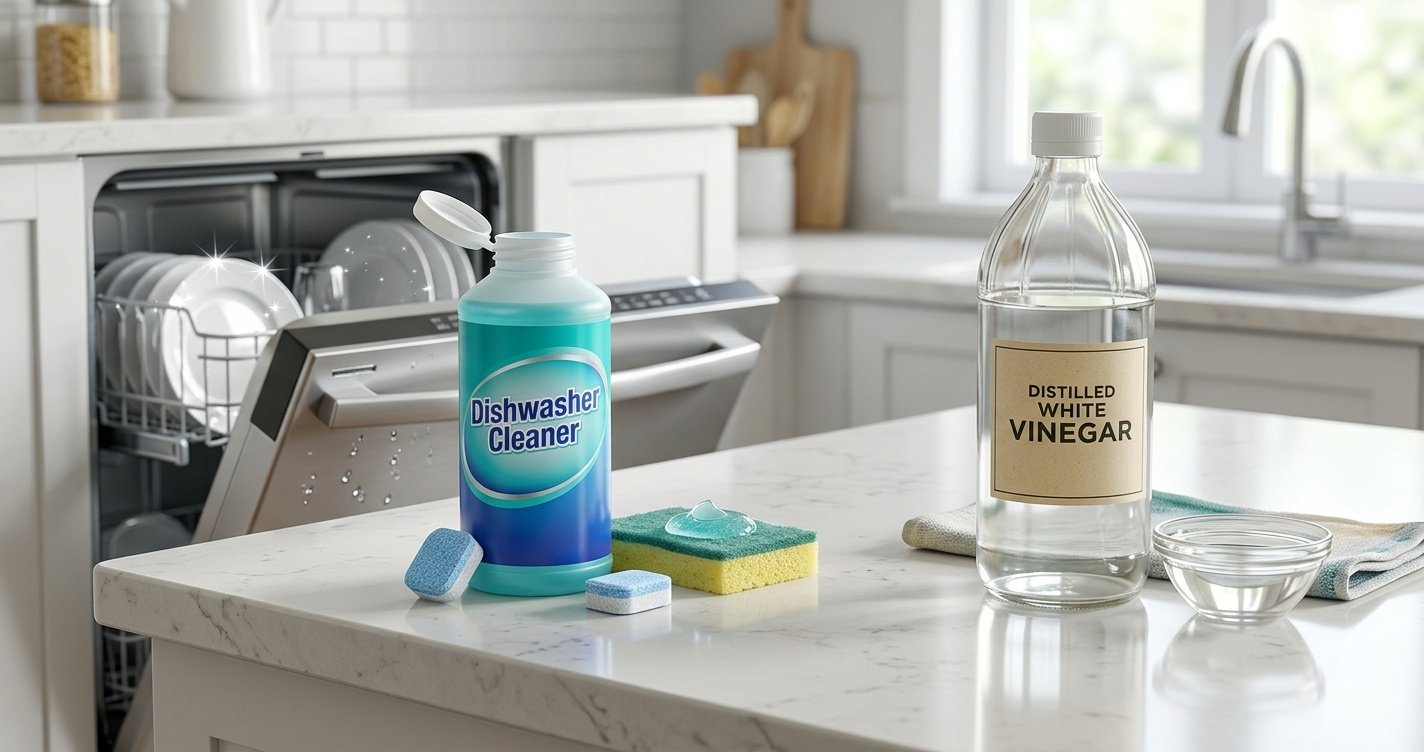
Dishwasher Cleaner vs. Vinegar at a Glance
| Feature | Dishwasher Cleaner | Vinegar |
| Grease and grime | Excellent | Good |
| Mineral deposits | Very good | Good |
| Odor control | Excellent | Good |
| Convenience | Very convenient | Simple but requires more preparation |
| Cost | Higher | Low |
| Formulated for dishwashers | Yes | No |
| Heavy buildup | Better choice | May require repeated treatments |
| Routine light cleaning | Excellent | Suitable in some situations |
What Is Dishwasher Cleaner?
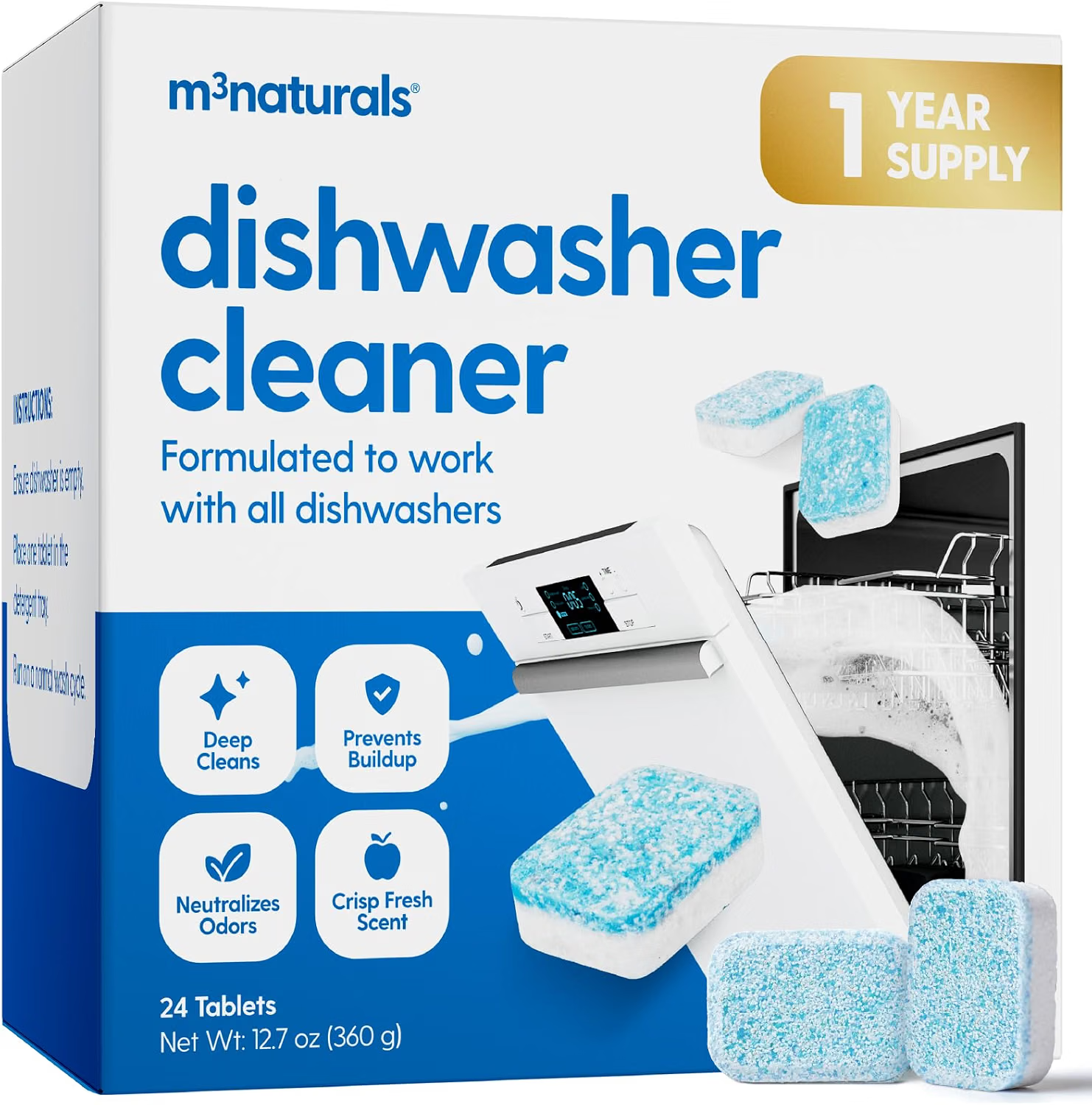
Commercial dishwasher cleaners are products specifically designed to clean the inside of a dishwasher. Depending on the formulation, they may target grease, limescale, mineral deposits, food residue, and odors.
Many dishwasher cleaners are designed to be used in an empty dishwasher on a specific wash cycle. Because the product is formulated for appliance cleaning, it can be a more consistent choice when the dishwasher has noticeable buildup.
Advantages of dishwasher cleaner
- Designed for the appliance: The formula is intended specifically for dishwasher cleaning.
- Better for stubborn buildup: Specialized ingredients can be more effective against grease, grime, and mineral deposits.
- Convenient: Most products require little preparation.
- Consistent results: Following the manufacturer’s directions gives you a predictable cleaning process.
Disadvantages
- It costs more than household vinegar.
- Different products have different instructions, so you need to read the label.
- Some formulas may contain stronger cleaning agents than you would use for everyday household cleaning.
What About Vinegar?
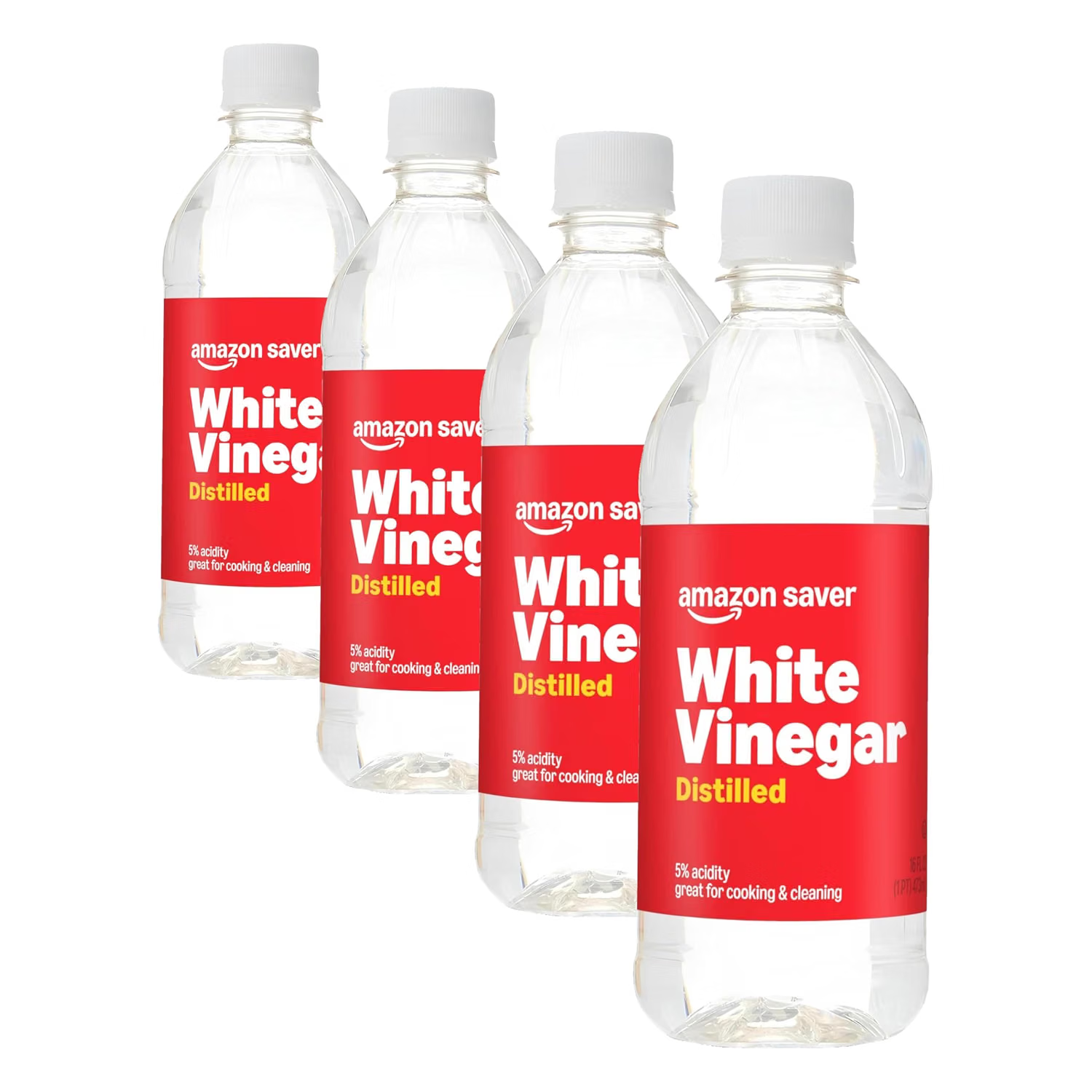
White vinegar is a mild acid that can help dissolve some mineral deposits and loosen certain residues. It is also inexpensive and widely available, making it a popular DIY dishwasher-cleaning method.
For light mineral buildup or odors, vinegar may provide a simple cleaning boost. However, it isn’t specifically formulated to clean dishwashers, and it may not perform as well as a dedicated cleaner on heavy grease or stubborn deposits.
Advantages of vinegar
- Inexpensive: A bottle of white vinegar is usually much cheaper than specialty cleaning products.
- Easy to find: It is commonly available in grocery stores.
- Useful against mineral residue: Its acidity can help with some hard-water deposits.
- Simple: It doesn’t require buying a dedicated appliance-cleaning product.
Disadvantages
- Less powerful against heavy grime: Vinegar isn’t a specialized degreaser or dishwasher cleaner.
- Results can vary: It may not remove significant buildup in one cleaning cycle.
- Not universally recommended: Some dishwasher manufacturers advise against using vinegar inside their machines, particularly in certain ways or concentrations.
Which Cleans Better?
For overall dishwasher maintenance and heavy buildup, a dishwasher cleaner is usually the better choice.
A commercial cleaner is formulated with dishwasher cleaning in mind, so it can address a broader range of residues. This is especially useful if your dishwasher has visible grime, a persistent odor, or mineral buildup.
Vinegar can be adequate for occasional light cleaning, particularly when mineral deposits or mild odors are the main concern. However, it shouldn’t automatically be considered a substitute for a dedicated dishwasher cleaner.
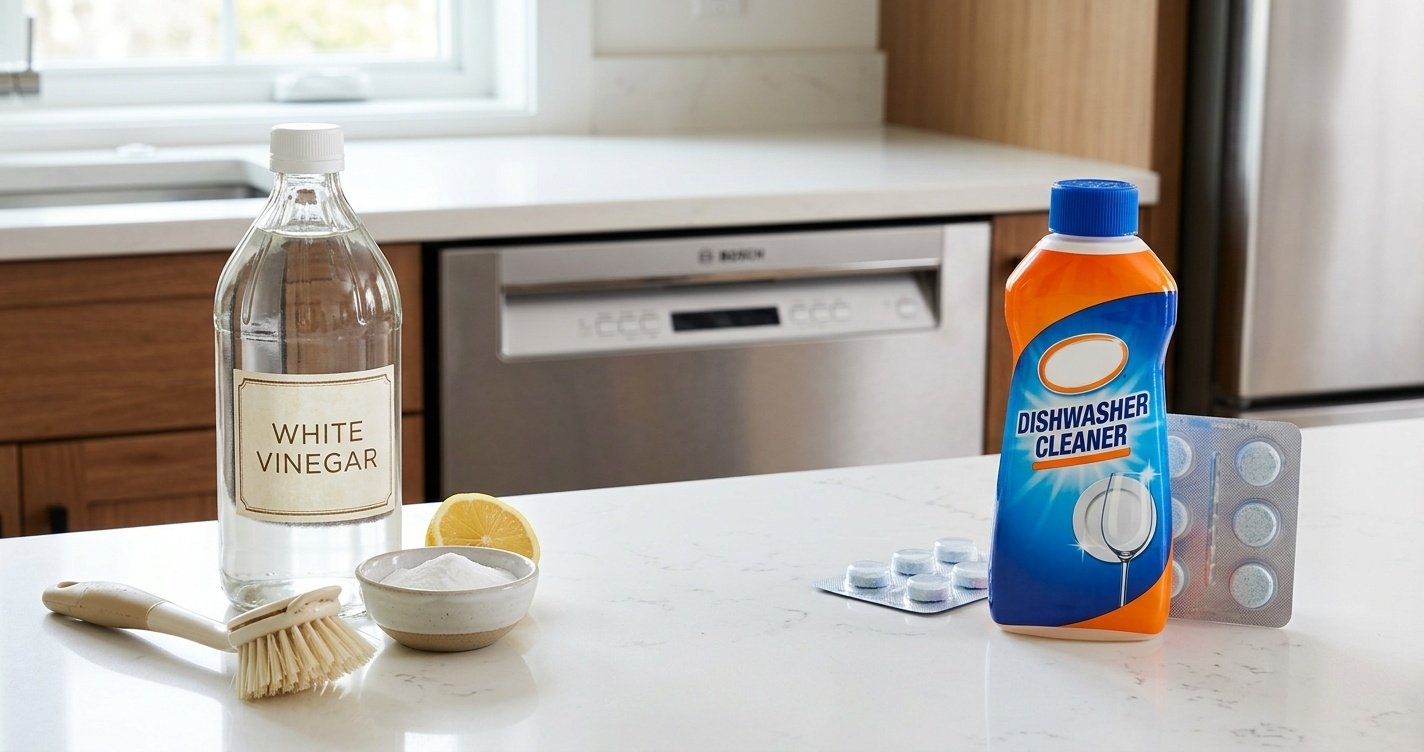
Which Is Better for Hard-Water Deposits?
This is where vinegar can be useful. Its acidity helps break down some mineral deposits left behind by hard water.
However, a dishwasher cleaner designed to tackle limescale or mineral buildup may be a better option when deposits are extensive. If you regularly see white or chalky residue inside the dishwasher, check your dishwasher’s manual and consider a product specifically labeled for mineral buildup.
Which Is Better for Odors?
Both options can help with dishwasher odors, but the cause of the smell matters.
Food particles trapped in the filter, spray arms, door seals, or other areas can create odors. Simply running vinegar through the machine won’t necessarily remove the source.
Before using any cleaner:
- Remove visible food debris.
- Clean the dishwasher filter according to the manufacturer’s instructions.
- Wipe the door gasket and edges.
- Check the spray arms for blocked openings.
- Run an appropriate cleaning cycle.
If the odor persists, a dedicated dishwasher cleaner may provide a more thorough treatment.
Is Vinegar Safe for Every Dishwasher?
Not necessarily.
This is an important distinction. Always check your dishwasher manufacturer’s care instructions before using vinegar. Some manufacturers discourage or limit its use because repeated exposure to acidic substances may affect certain rubber components, seals, or other materials.
Also, never mix vinegar with chlorine bleach or products containing bleach. Combining acids such as vinegar with chlorine bleach can produce dangerous chlorine gas.
Dishwasher Cleaner vs. Vinegar: Which Should You Choose?
Choose dishwasher cleaner if:
- Your dishwasher has heavy grease or grime.
- You have persistent odors.
- You notice significant mineral buildup.
- You want a product specifically designed for dishwasher maintenance.
- Your dishwasher manufacturer recommends a particular cleaning product.
Choose vinegar only when:
- Your manufacturer’s instructions allow it.
- You are dealing with relatively light mineral residue or odors.
- You want a low-cost household option.
- You understand that it may not replace a dedicated dishwasher cleaner.
Frequently Asked Questions
Is dishwasher cleaner better than vinegar?
Generally, yes. Dishwasher cleaner is specifically formulated to remove grease, grime, mineral deposits, and odors from dishwashers. Vinegar can help with light mineral buildup and odors but may be less effective on heavy residue.
Can I use vinegar instead of dishwasher cleaner?
Sometimes. Check your dishwasher manufacturer’s instructions first. If vinegar is approved, it may be suitable for occasional light cleaning, but it isn’t a direct replacement for every type of dishwasher cleaner.
How often should I clean my dishwasher?
For most households, cleaning the dishwasher about once a month is a reasonable starting point. You may need to clean it more often if you notice odors, visible buildup, or frequent food residue.
Does vinegar remove dishwasher odors?
Vinegar can help reduce some odors, but it may not eliminate the source of a persistent smell. Cleaning the filter, door gasket, and other areas where food particles collect is also important.
Does vinegar remove limescale from a dishwasher?
Yes, vinegar’s acidity can help dissolve some mineral deposits and limescale. However, a dishwasher cleaner specifically designed for limescale may be more effective when buildup is significant.
Can vinegar damage a dishwasher?
Repeated or improper use of vinegar may affect certain dishwasher materials or components. Because manufacturers have different recommendations, always check your appliance’s owner’s manual before using vinegar.
Can I use vinegar and dishwasher cleaner together?
No. Do not mix cleaning products unless the manufacturer’s instructions specifically say that they are compatible. In particular, never mix vinegar with bleach or products containing chlorine.
Should I put vinegar in the dishwasher with dishes?
It is generally better to follow the dishwasher manufacturer’s instructions rather than adding vinegar during a normal dishwashing cycle. If vinegar is permitted for cleaning, use it according to the appliance or product instructions.
What is the best way to clean a dishwasher?
Start by removing food debris and cleaning the filter and seals. Then use a dishwasher cleaner approved for your appliance if deeper cleaning is needed. Regular maintenance can help prevent odors and buildup.
Is dishwasher cleaner worth it?
For households dealing with grease, hard-water deposits, or persistent odors, a dedicated dishwasher cleaner can be worth the cost. It provides a more targeted solution than a basic household ingredient such as vinegar.
The Bottom Line
When comparing dishwasher cleaner vs. vinegar, neither option is automatically best for every situation. Dishwasher cleaner is the better all-around choice for deep cleaning and stubborn buildup because it is specifically formulated for the job. Vinegar can be a low-cost option for some light cleaning tasks, particularly mineral residue, but its use should be compatible with your dishwasher manufacturer’s recommendations. For the best results, regular basic maintenance matters just as much as the cleaning product. Keeping the filter, seals, spray arms, and interior free of food debris can help prevent odors and buildup before they become a bigger problem.
In short: use a dishwasher cleaner for targeted, thorough maintenance, and consider vinegar only when your dishwasher’s manufacturer says it is appropriate.